
Photos
[NEW] Please, check the IEEE BMSB 2026 – Conference Photos here
Share photos with #BMSB2026 !
Program
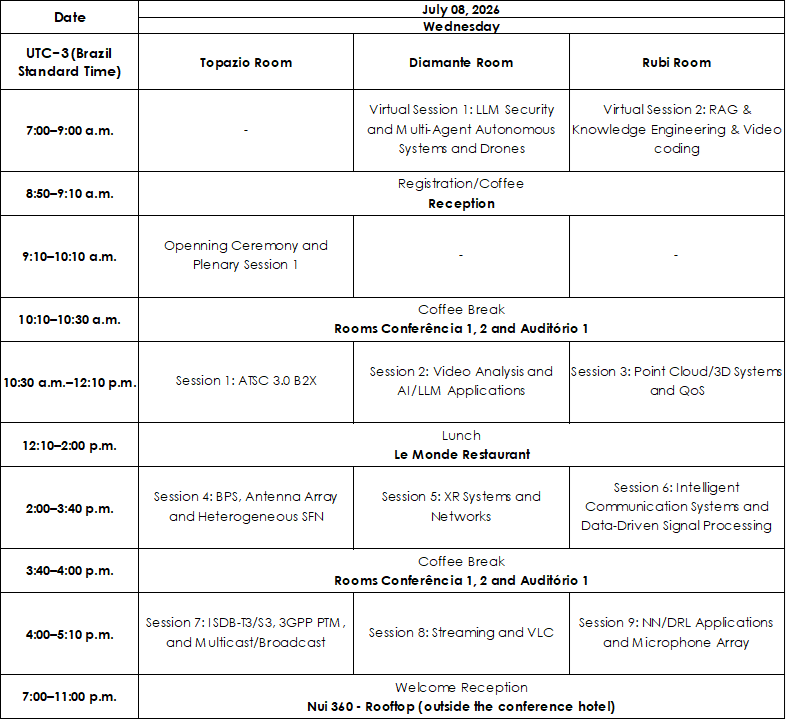
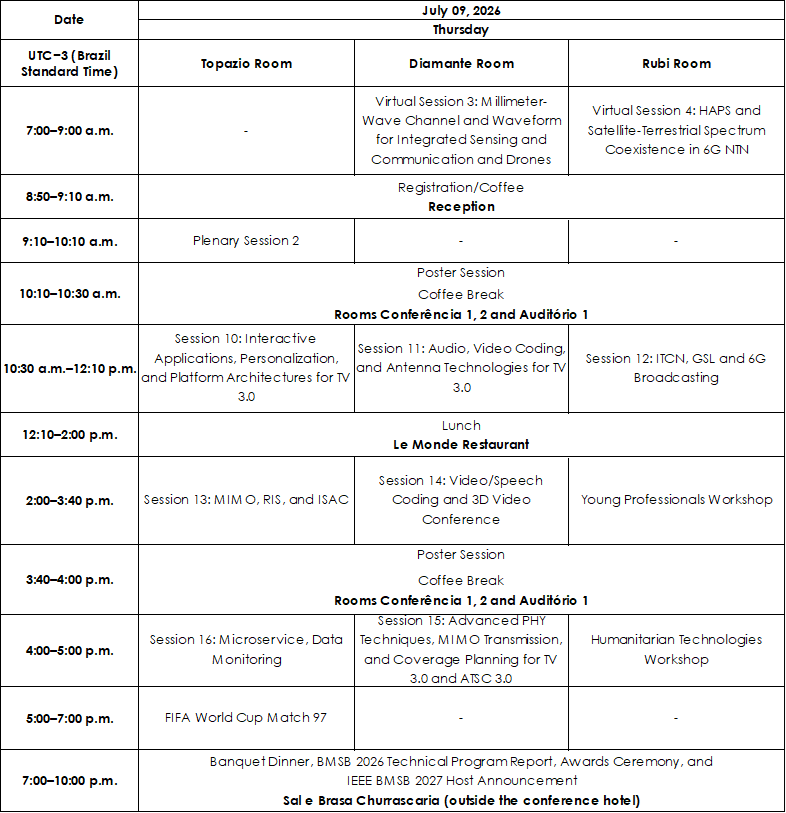
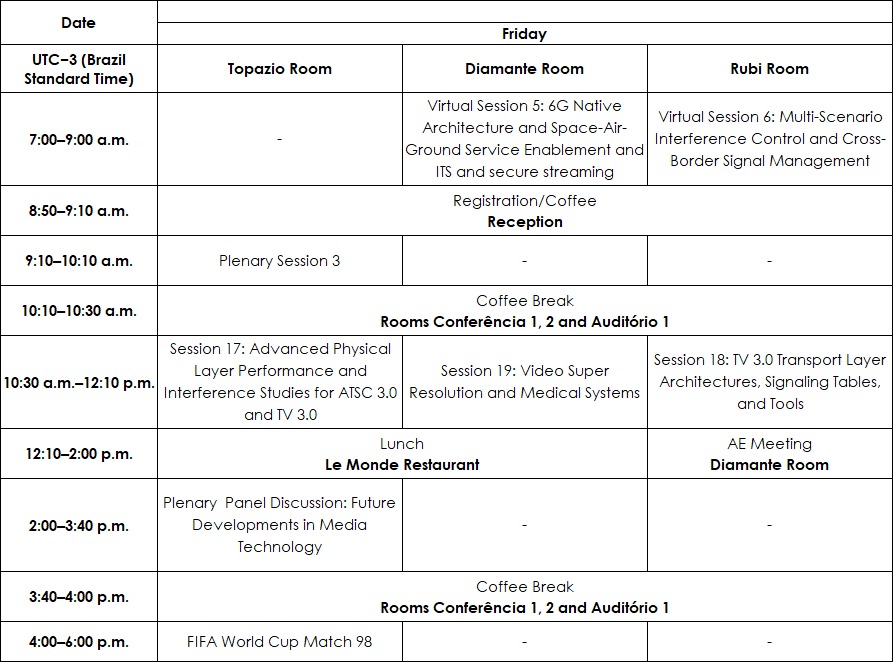
Friday – July 10, 2026 – Extended version here
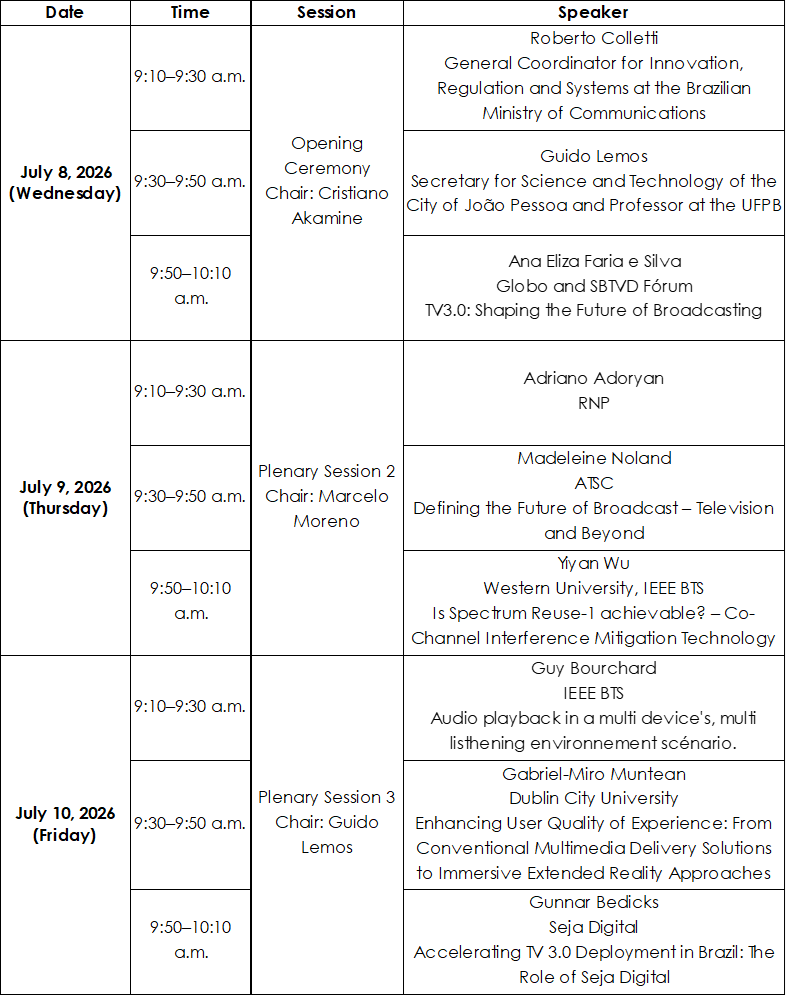
Plenaries
Keynote Speakers
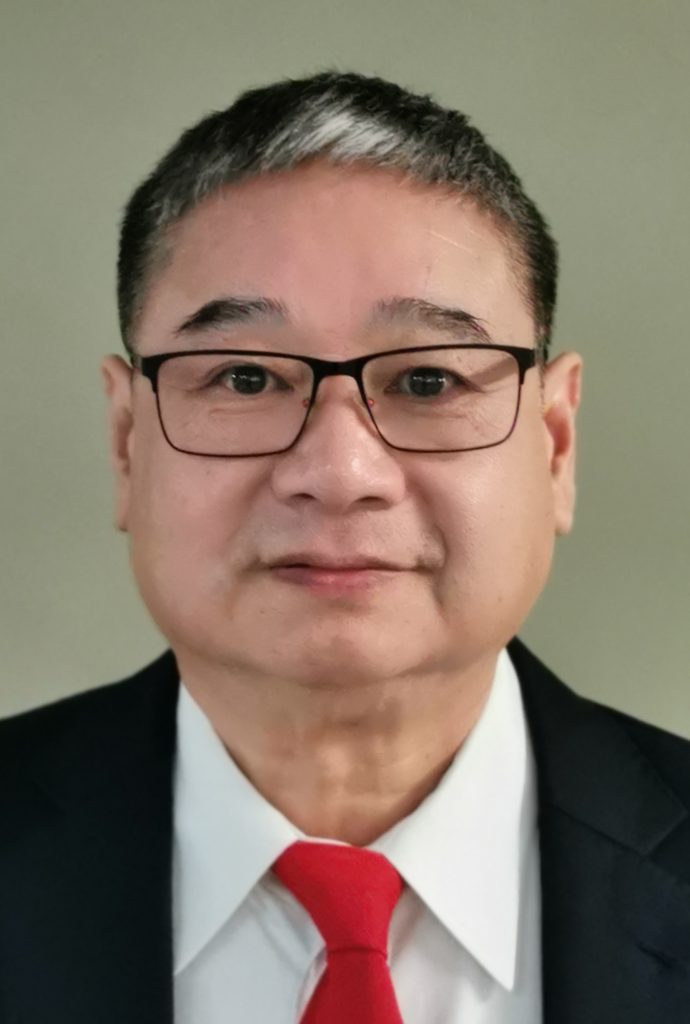
Dr. Yiyan Wu is a Research Professor at Western University, London, Ontario. He was a Principal Research Scientist at the Communications Research Centre Canada (CRC) from 1992 to 2024. His research interests include broadband multimedia communications, signal processing, and communication systems engineering. He is a Fellow of the IEEE (2001) and a Fellow of the Canadian Academy of Engineering (2013). Dr. Wu is an Editor-in-Chief Emeritus of the IEEE Transactions on Broadcasting and a member of the ATSC Board of Directors, representing IEEE. He was named a Member of the Order of Canada in 2018.
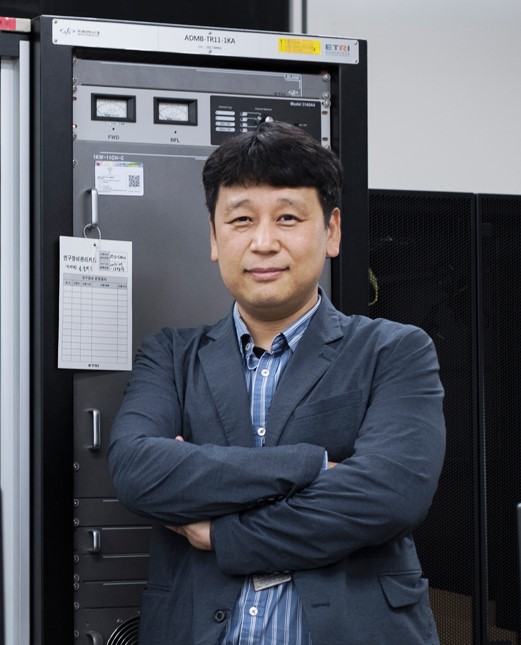
Dr. Sung-Ik Park (IEEE Fellow) joined the Broadcasting System Research Group at the Electronics and Telecommunications Research Institute (ETRI), Korea, in 2002. Since then, he has played a leading role in terrestrial broadcasting standardization, as well as the hardware and software implementation, laboratory validation, and large-scale field testing of advanced digital broadcasting systems. He is currently a Principal Research Staff Member at ETRI and leads multiple research projects related to next-generation digital television (DTV) systems. His research interests include error correction coding, digital communications, and signal processing technologies for digital broadcasting systems, with particular emphasis on advanced physical-layer technologies for next-generation terrestrial broadcasting. He has authored and co-authored more than 350 peer-reviewed journal and conference papers and has actively contributed to numerous international broadcasting standardization activities and collaborative projects. He has received many prestigious international and national honors, including the Richer Industry Leadership Medal (2024), two Prime Minister’s Awards of Korea (2019 and 2024), two Scott Helt Memorial Awards (2009 and 2019), more than ten IEEE BMSB Best Paper Awards, the KBS President’s Award (2022), the Top 10 National R&D Award of Korea (2018), and two Best 100 National R&D Awards of Korea (2019 and 2025). He currently serves as an Associate Editor of IEEE Transactions on Broadcasting and ETRI Journal, a Distinguished Lecturer of the IEEE Broadcasting Technology Society (BTS), the Chair of the IEEE BTS Daejeon Chapter, and a member of the IEEE BMSB International Steering Committee.
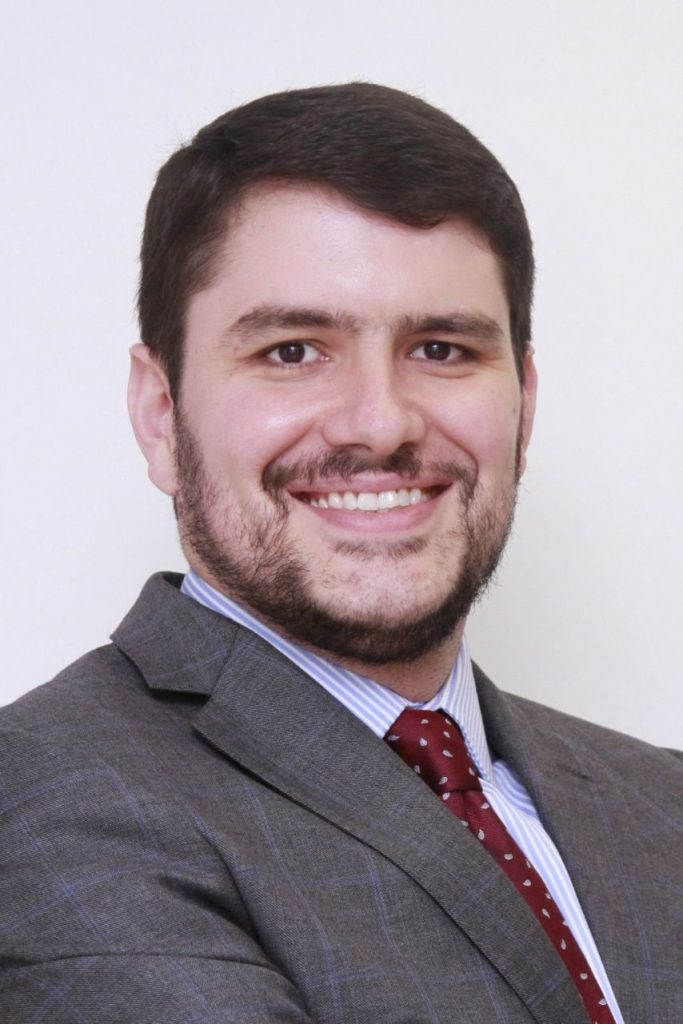
Roberto Colletti is the General Coordinator for Innovation, Regulation and Systems at the Brazilian Ministry of Communications. He leads strategic initiatives to modernize Brazil’s broadcasting sector, including the implementation of TV 3.0, the evolution of the regulatory framework, and the development of digital solutions for public administration. With more than a decade of experience in communications policy, he represents Brazil in international broadcasting and radiocommunication forums, including the ITU-R, CITEL, and the ISDB-T International Forum.
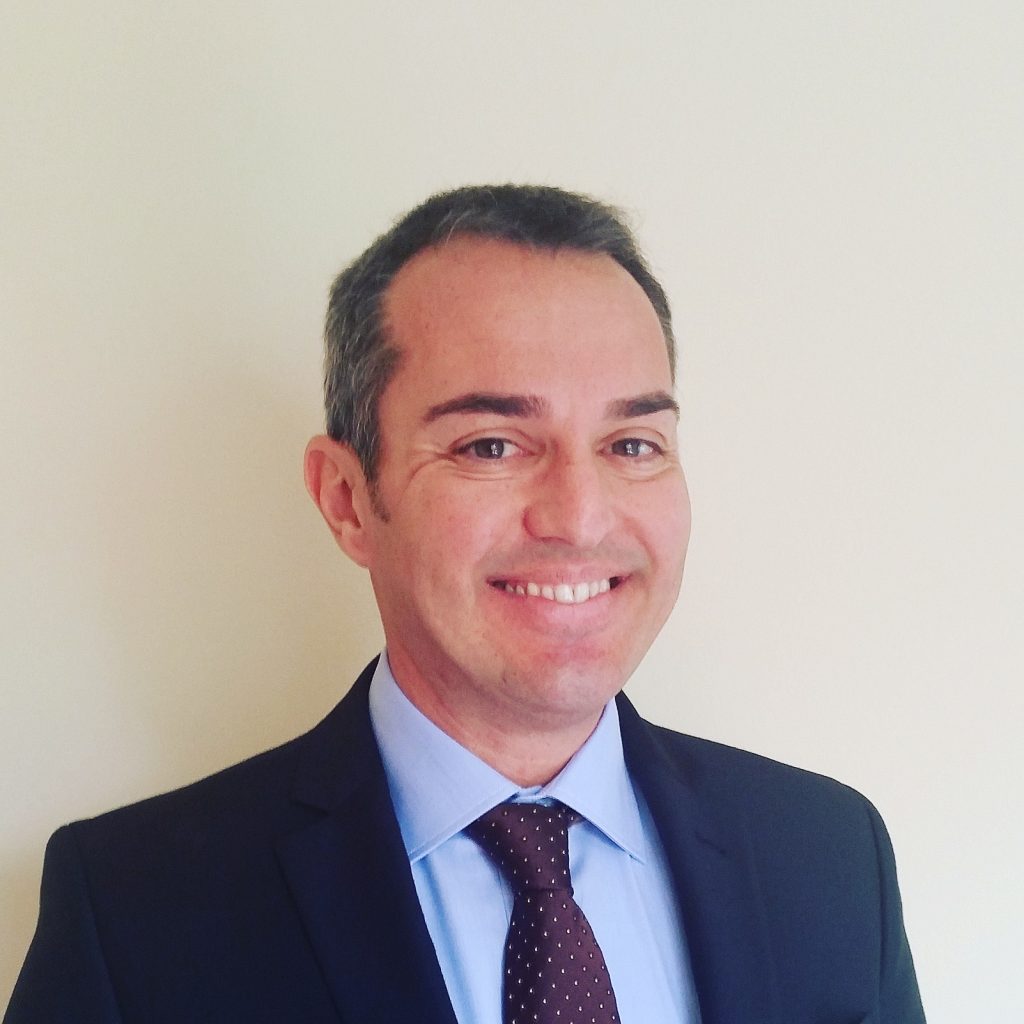
Maurizio Murroni, Ph.D, is professor of Telecommunications at the Department of Electrical and Electronic Engineering (DIEE) of the University of Cagliari. In 2016 he founded the Italian chapter of the Broadcast Technology Society (BTS) of the Institute of Electrical and Electronic Engineering (IEEE). Since 2018 he has been distinguished lecturer for BTS on the topic quality of experience (QoE) for advanced broadcast services. Since 2020 is chair of the distinguished lecturer program and since 2025 VP Conference of BTS. Prof. Murroni is co-author of an extensive list of articles published in journals and on international conference proceedings and has received numerous awards and recognitions. He has served as chair for various international conferences and workshops. He is co-author of 1900.6-2011 – IEEE Standard for Spectrum Sensing Interfaces and Data Structures for Dynamic Spectrum Access and other Advanced Radio Communication Systems and associate editor for IEEE Transactions on Broadcasting. Prof. Murroni is principal investigator (coordinator) of the Horizon Europe project HEAT – Hybrid Extended reality, GA- 101135637 on the call HORIZON-CL4-2023-HUMAN-01-21- Next Generation eXtended Reality. He was involved in the project QoE-Net – Quality of Experience maNagement in Emerging mulTimedia Service, Contract n. 643072, Marie Skłodowska-Curie Initial Training Network, funded by H2020-MSCA- ITN, in 2012-2016, in the project MAVEN – Management and Authenticity Verification of multimedia contENts, funded by EU FP7 from 2013-2015, in the ICT COST Action IC1003 QUALINET, “European Network on Quality of Experience in Multimedia Systems and Services”, in 2012 – 2016 and in the ICT COST Action 3DConTourNet – 3D content creation, coding and transmission over future media networks in 2012-2016. His research focuses on immersive XR communications, QoE, HbbTV, multi sensorial media, broadcast/multicast delivery on B5G networks. Prof. Murroni is a member of the Association for Computer Machinery, senior member of IEEE, IEEE ComSoc, IEEE BTS, IEEE VTS, IEEE SP, AESS.
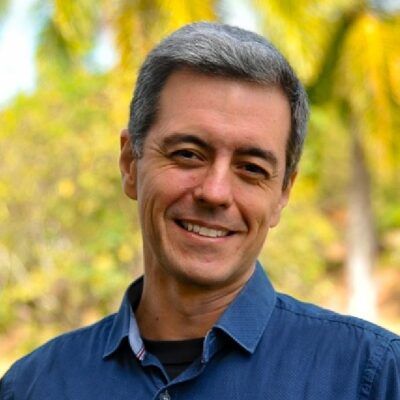
Marcelo Moreno is an associate professor at the Federal University of Juiz de Fora (UFJF). He holds a Ph.D. in Computer Science from PUC-Rio and specializes in multimedia systems and computer networks. In 2022–2023, he was a visiting professor at the International Audio Laboratories Erlangen (FAU/Fraunhofer IIS) in Germany. As co-editor of ITU-T Recommendation H.761 (“NCL and Ginga-NCL”), he has contributed to various international standards and coordinated working groups at ITU-T for over a decade. Since 2015, he has coordinated the Application Coding Working Group of the Brazilian Digital TV System Forum (SBTVD), where he also serves as editor of the ABNT standards for TV 2.5 and TV 3.0. His research integrates academic innovation and technical standardization, focusing on application-oriented broadcasting, integration with second-screen devices, audience measurement, and privacy-supporting media platforms for the new generation of digital TV.
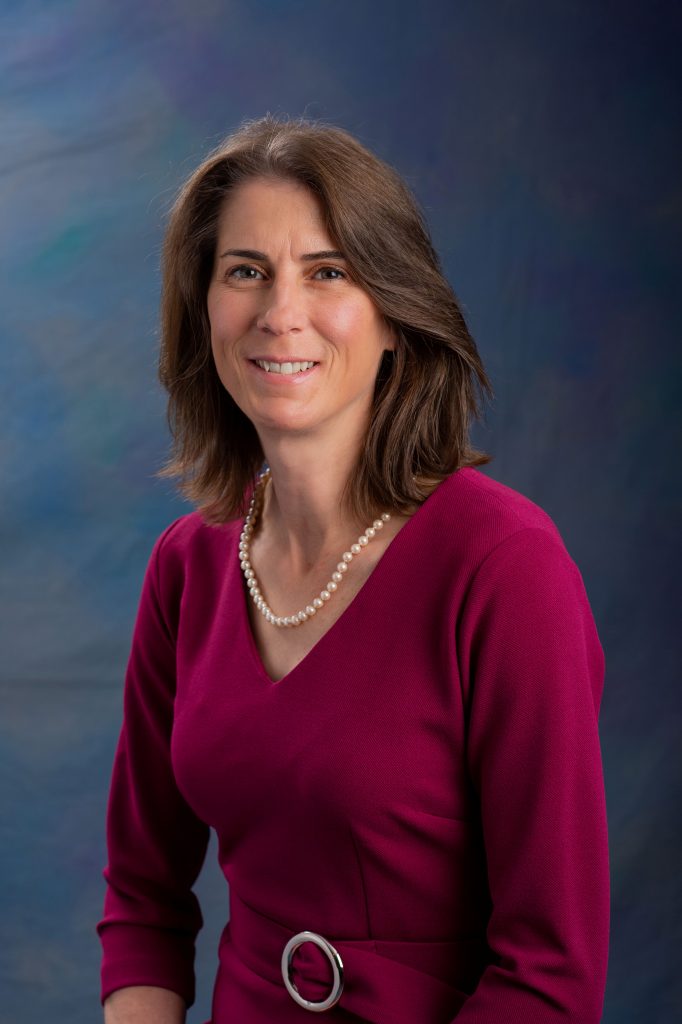
Madeleine Noland is the President of ATSC, the Broadcast Standards Association. A 20-year industry veteran who is widely respected for her consensus-building leadership style, she chaired the technology group that oversees the ATSC 3.0 next-generation broadcast standard before being named ATSC President in May 2019. Previously, she chaired various ATSC 3.0-related specialist groups, ad hoc groups and implementation teams since 2012. Noland began her career in the television industry in 2004 with Backchannelmedia Inc., an interactive television technology developer. It was during her work there that she first became involved in ATSC projects. In 2012, she moved on to product and project management roles at Telvue Corp. before joining LG Electronics CTO’s office in 2013. Noland represented LG in a variety of industry organizations for over six years. Most recently, Madeleine was awarded the prestigious 2022 David Sarnoff Medal by the Society of Motion Picture & Television Engineers (SMPTE) in a ceremony held in Hollywood, California. She has also received TV NewsCheck’s “2019 Futurist” Women in Technology Award and was named one of 2018’s “Powerful Women in Consumer Technology” by Dealerscope magazine. In 2016, while the Chair of TG-3, she received the ATSC’s highest technical honor, the Bernard J. Lechner Outstanding Contributor Award recognizing her leadership related to the development of ATSC 3.0 Next Gen TV. Credited on three U.S. patents for television technology, Noland is a member of the Society of Motion Picture and Television Engineers, the Society of Cable Telecommunications Engineers, and the Institute of Electrical and Electronics Engineers – Broadcast Technology Society. Noland graduated cum laude from the University of Massachusetts. She enjoys travel, and she plays keyboards in a band called “Brave Pursuit.”
Guy Bouchard currently serves as Vice President of the IEEE Broadcast Technology Society, prior to retiring two years ago, Guy held a range of roles including lab engineer, senior manager of engineering, Director of Transmission, and Director of Technical Operations—at both CBC/Radio-Canada and Télé-Québec. His expertise spans analog and digital television transmission and production systems, as well as satellite and terrestrial microwave communications. He holds a degree in telecommunications from the Université du Québec and currently serves as Vice President of the IEEE Broadcast Technology Society Administrative Committee (AdCom). Since 1979, Guy has been actively involved in the broadcast industry, with a particular focus on digital communication systems. He has authored and presented numerous papers on digital television (DTV), satellite technology, and MPEG transport systems for organizations such as NAB, CCBE, IEEE, Canadian Digital Television (CDTV), and the Society of Motion Picture and Television Engineers (SMPTE) and authored the Chapter on ATSC of the book ‘Digital television Fundamental’s’ published by IET,
Gunnar Bedicks is a professor, researcher, and telecommunications expert with over 30 years of experience in technologies and systems for analog and digital communications. In 2013, he received the Order of Rio Branco from the Brazilian Ministry of Foreign Affairs for his role in expanding the Brazilian Digital TV System across South America, Central America, and Africa. He served for 15 years as Chief Researcher at the Digital TV Laboratory of Mackenzie Presbyterian University in São Paulo and spent 18 years as a faculty member in the university’s Electrical Engineering programs. He also coordinated the digital TV tests that led the Brazilian government to adopt the ISDB-T standard for the national Digital TV System in 2004. Since 2015, he has been the CTO of EAD, the entity responsible for enabling the release of the 700 MHz spectrum for 4G services. He is currently leading six major public policies initiatives projects, including the development and evolution of the SBTVD — TV 3.0 project. He is also an IEEE Life Member.
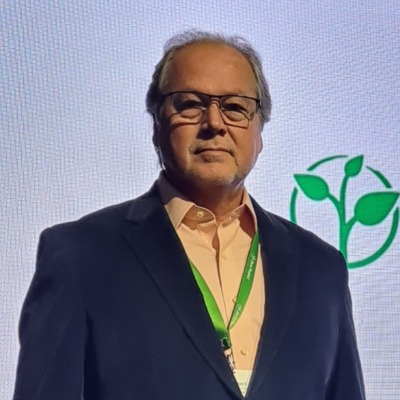
Guido Lemos holds PhD in Computer Science from the Pontifical Catholic University of Rio de Janeiro (PUC-RIO). He coordinates LAVID (Research and Extension Center in Digital Video Applications), where he conducts research in the following areas: digital television, digital cinema, distributed multimedia applications, video distribution networks, distributed artistic performances, accessibility, information security, fake news, telehealth, and blockchain applications. He participated in the development of the Ginga middleware, published as ITU-T and ITU-R recommendations, and adopted as the standard in the Brazilian Digital Television System and in several other Latin American countries. Its implementation is a software currently installed on approximately 100 million TV sets. Other highlights of his research include the development of a system for storage, transmission, and display of 4K 3D videos called Fogo Player; the development of a platform to support distributed performances in dance, theater, and music called Arthron; the development of video servers for live and on-demand streaming, called DLive and DVod, which were used in RNP’s Digital Video Network and in USP-SP’s IPTV service; the accessibility software VLibras (used on the websites www.brasil.gov.br, senado.leg.br, and câmara.leg.br), executed 1.5 billion times per year; the development of technologies for registration, validation, and preservation of Digital Diplomas based on blockchain, which will be used in 270 public universities in Brazil; and finally, the development of the V4H health video system, which uses digital signature technologies, blockchain registration, and preservation to enhance security in the use of videos generated during medical consultations. He was the coordinator of the REUNI program at UFPB and participated in its creation and implementation, resulting in an increase from 20,000 to 45,000 undergraduate and graduate students. He also serves as a member of the Deliberative Council of the Brazilian Digital Television System Forum and is a guest of Ancine’s Technical Accessibility Chamber.
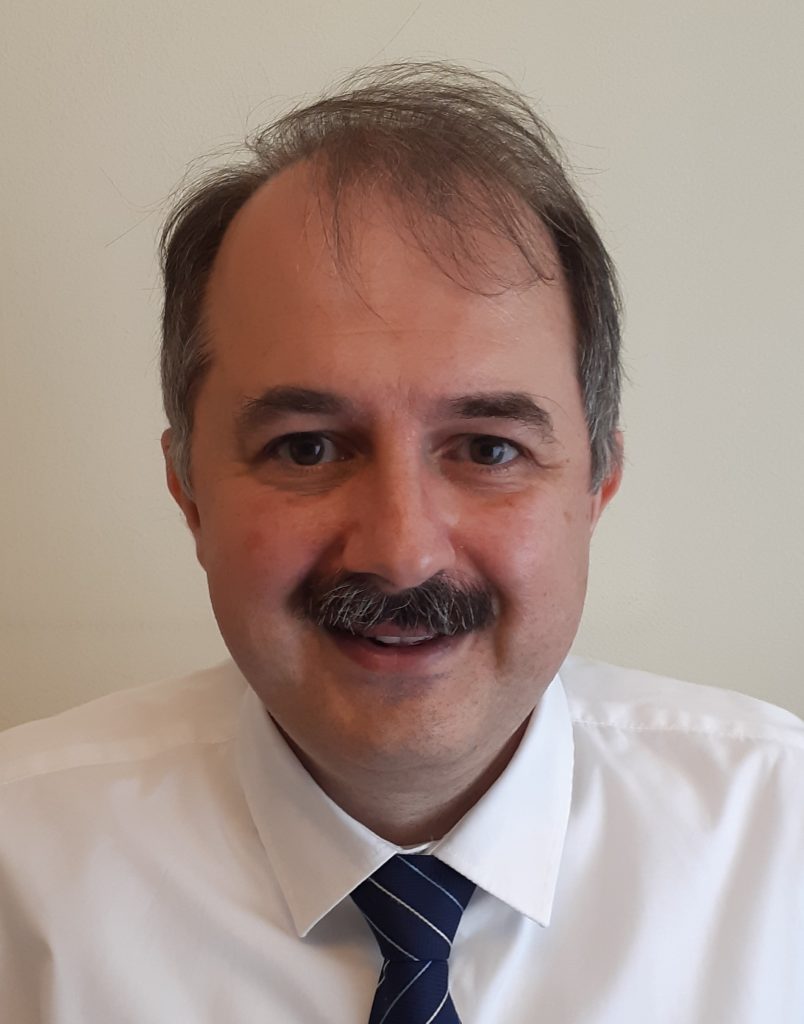
Prof. Gabriel-Miro Muntean received his Ph.D. degree for research on adaptive multimedia delivery from Dublin City University (DCU), Ireland, in 2004, where he is a Professor with the School of Electronic Engineering and co-Director of the DCU Performance Engineering Laboratory. He has published over 600 papers in top-level international journals and conferences, authored 4 books and 29 book chapters and edited 9 additional books and proceedings, which attracted over 15000 citations. Prof. Muntean’s research interests include quality, performance, and energy saving issues related to distribution of multimedia, multiple sensorial amd extended reality content in heterogeneous network environments. He is an Associate Editor of the IEEE Transactions on Broadcasting and IEEE Transactions on Network Science and Engineering, the Multimedia Communications Area Editor of the IEEE Communications Surveys and Tutorials, and chair and reviewer for important international journals, conferences, and funding agencies. He is a Fellow of the IEEE and an active member of the IEEE Broadcast Technology Society. He coordinated and participated in EU or Irish-funded large scale projects such as NEWTON, TRACTION, NEXT, FRADIS and HEAT.

Dazhi He is a Professor at Shanghai Jiaotong University and the Chief Technology Officer of the National Engineering Research Center of Digital TV in China. He has in-depth research experience on the technology and standardization development of terrestrial digital TV in China (DTMB), direct satellite broadcasting (ABS-S), next-generation digital TV standards (ATSC3.0), and 3GPP 5G broadcasting. He has published more than 70 papers in IEEE journals and granted more than 70 patents (Including 20 PCT patents). He won the second prize of the national scientific and technological progress award in China and the first prize of the science and technology progress award in Shanghai. His main research interests include Intelligent media communications and heterogeneous network.
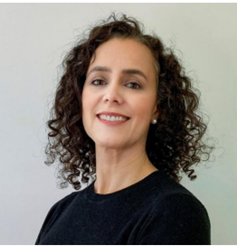
Ana Eliza is Head of Technical Regulatory Affairs at Globo, Latin America’s largest media group, with over 25 years of experience in transmission engineering, regulatory policy, and broadcasting standards. She has held leadership roles at the Brazilian Society of Television Engineering and the SBTVD Forum and has represented Brazil in ITU activities and World Radiocommunication Conferences since 2002. In 2026 she received the Women in Technology Leadership Award.
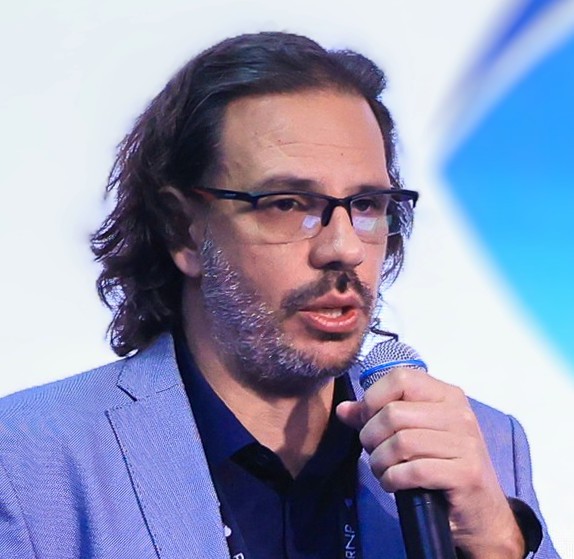
Adriano Adoryan is a Solutions Manager at RNP (Rede Nacional de Ensino e Pesquisa, the Brazilian National Research and Education Network), managing the research for Phases three and four of TV 3.0 in Brazil. He holds a PhD in Audiovisual Media and Processes from ECA-USP, with a thesis on television business models. With over 20 years of experience as a television executive, he worked for 12 years at EBC, Brazil’s federal public broadcasting company, where he led flagship initiatives such as the MAM digital archive, the TV Brasil Play app, and the Brasil 4D project. He combines innovation, strategic vision, and academic expertise to advance public broadcasting and digital media ecosystems.